
The Art of Yogic Sleep
There’s a practice that asks you to do almost nothing — lie down, close your eyes, and listen — yet leaves people feeling as refreshed as a full night’s sleep. It’s called Yoga Nidra, or “yogic sleep,” and it may be the most accessible practice in the entire yoga tradition.
At Ujain Yoga Studio, we often close Restorative and Yin sessions with a short Yoga Nidra, and it’s consistently the part students ask us to teach them to do at home.
What Is Yoga Nidra?
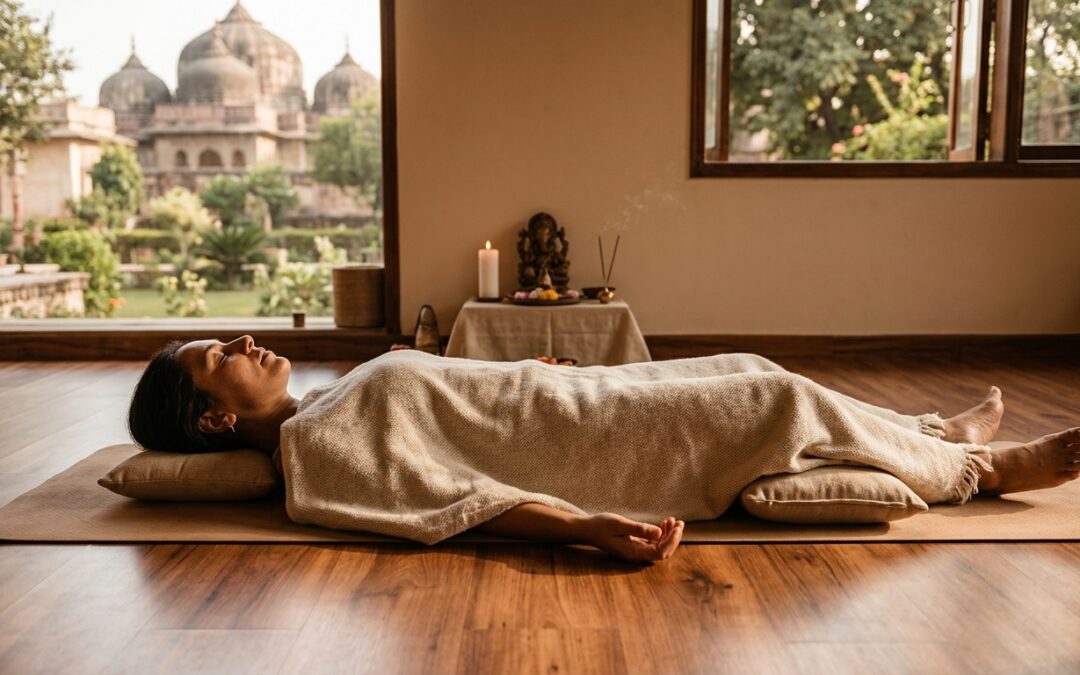
Yoga Nidra is a guided meditation practiced lying down (usually in Savasana), where a teacher leads you through a structured sequence of body awareness, breath awareness, and visualization. Unlike seated meditation, there’s no effort to sit still or hold a posture — the body rests completely while the mind stays gently alert.
The name translates to “yogic sleep” because the practice guides you into the border state between waking and sleeping — a place where the brain shows patterns similar to the early stages of sleep, but awareness remains present. Practitioners often say one hour of Yoga Nidra can feel as restorative as three or four hours of actual sleep.
How a Yoga Nidra Session Works
A typical session moves through several stages:
- Settling in — lying down, getting comfortable, initial relaxation
- Setting an intention (Sankalpa) — a short, personal phrase held in the mind
- Body scan (rotation of consciousness) — systematically bringing awareness to different body parts
- Breath awareness — noticing the natural rhythm of breathing
- Visualization or imagery — guided images or sensations
- Return to the intention — revisiting the Sankalpa
- Gentle re-awakening — slowly bringing awareness back to the room
The entire practice is passive — no stretching, no movement — just following the voice of the guide.
Benefits of Yoga Nidra
1. Deep Physical and Mental Rest
Because the body fully relaxes while the mind stays softly aware, Yoga Nidra can reduce fatigue in ways that regular rest sometimes doesn’t.
2. Reduced Stress and Anxiety
The guided structure interrupts anxious thought loops, giving the nervous system a genuine break from constant mental activity.
3. Better Sleep Quality
Regular practice has been linked to falling asleep faster and experiencing deeper, more restful sleep at night.
4. Improved Focus and Clarity
Many practitioners report sharper concentration and decision-making after consistent practice, likely linked to reduced mental fatigue.
5. Emotional Processing
The relaxed, receptive state can allow suppressed emotions or stress to surface and release gently, without needing to “work through” anything actively.
Who Should Try Yoga Nidra?
- Anyone dealing with poor sleep or insomnia
- Highly stressed professionals needing quick, deep recovery
- Students who find seated meditation difficult
- People recovering from burnout, illness, or emotional strain
- Practitioners of any yoga style looking to deepen their practice
Because it requires no physical exertion, Yoga Nidra is one of the few practices suitable for nearly everyone, including those with injuries or limited mobility (always mention any concerns to your instructor beforehand).
How to Get Started
The biggest challenge with Yoga Nidra isn’t physical — it’s staying awake enough to remain aware while the body drifts toward sleep. A skilled guide makes a significant difference here, pacing the session and using voice and silence intentionally.
At Ujain Yoga Studio, we teach Yoga Nidra as both a standalone practice and a closing element of our Restorative and Yin sessions, so you can experience it in the way that suits you best.
Curious what deep, conscious rest feels like? Get in touch to book a session, or explore our class calendar.


