
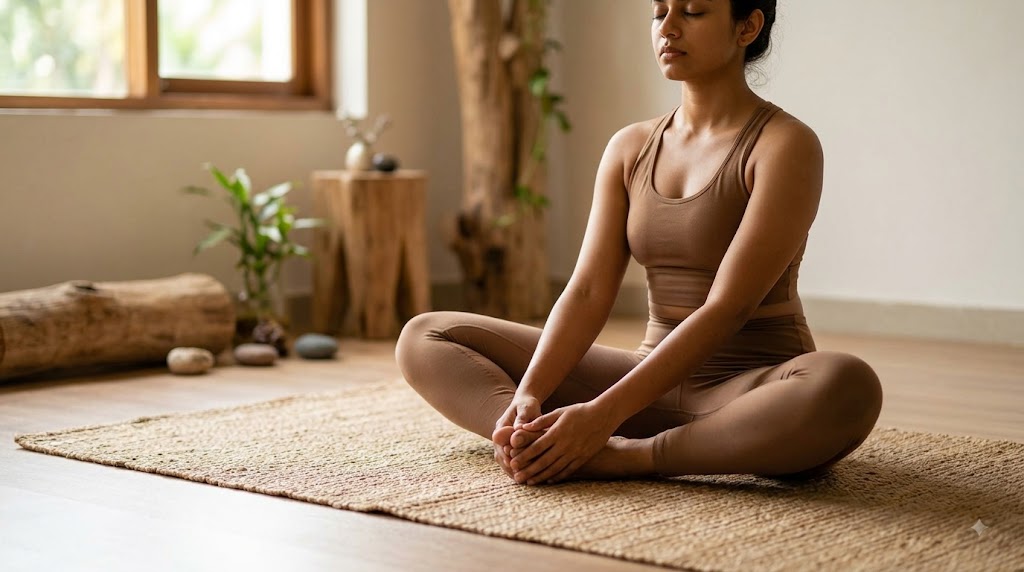
The Slow Path to Deep Release and Inner Calm
If your days feel like a constant sprint — meetings, deadlines, notifications — your nervous system may be stuck in “go” mode long after you’ve stopped moving. Yin Yoga is the antidote. It’s a slow, quiet practice built around long-held, passive poses that work into the deep connective tissues of the body while calming a turbulant mind.
At Ujain Yoga Studio, Yin is one of the practices we weave into our meditative sessions alongside Yoga Nidra and Pranayama — and it’s often the class people say they didn’t know they needed until they tried it.
What Is Yin Yoga?
Where Vinyasa or Ashtanga build heat through movement and muscle engagement, Yin Yoga does the opposite. Poses are held for 3 to 5 minutes (sometimes longer), muscles stay relaxed, and gravity does the work. This allows the practice to reach the fascia, ligaments, and joints — tissues that rarely get direct attention in more dynamic styles.
It’s in Taoist principles of yin and yang: yang represents movement, heat, and activity; yin represents stillness, coolness, and surrender. A balanced practice — and a balanced life — needs both.
Key Benefits of Yin Yoga
1. Deep Flexibility and Joint Health
Long holds gently stretch connective tissue in ways active stretching can’t reach, gradually improving range of motion in the hips, spine, and shoulders.
2. Nervous System Reset
Stillness activates the parasympathetic nervous system — the body’s “rest and digest” state — lowering cortisol and easing chronic stress.
3. Better Sleep
Because Yin slows the breath and quiets mental chatter, many students notice falling asleep faster and sleeping more deeply on the days they practice.
4. Emotional Release
Holding a pose for several minutes often brings up sensation — and sometimes emotion. Many practitioners describe Yin as physically grounding but emotionally clarifying.
5. A Natural Complement to Active Practice
If you already do Vinyasa, Power Yoga, or strength training, Yin balances the yang effort with recovery — reducing injury risk and muscle tightness.
Beginner-Friendly Yin Yoga Poses
- Butterfly Pose (Baddha Konasana) — opens the hips and inner thighs
- Caterpillar Pose (seated forward fold) — releases the spine and hamstrings
- Sphinx Pose — gentle backbend for the lower back and chest
- Dragon Pose — deep hip flexor and quad opener
- Reclining Twist — releases tension along the spine
- Legs-Up-The-Wall — calming, great to close a session
Each pose is typically supported with props — a bolster, blanket, or block — so the body can fully relax without strain. No flexibility is required to begin; Yin meets you exactly where your body is today.
Who Should Try Yin Yoga?
- Beginners intimidated by fast-paced classes
- Desk workers with tight hips and rounded shoulders
- Athletes and gym-goers needing recovery days
- Anyone dealing with stress, anxiety, or poor sleep
- Practitioners of any level wanting to deepen flexibility over time
As with any practice, if you’re pregnant, recovering from injury, or managing a joint condition, let your instructor know beforehand so poses can be modified safely.
How to Get Started
You don’t need to be flexible, calm, or experienced to begin Yin Yoga — you just need to show up and be willing to sit still for a few minutes at a time. That’s often the hardest and most rewarding part.
At Ujain Yoga Studio, our sessions are kept small so every student gets hands-on guidance and pose modifications suited to their body. Whether you join us in person or online, we’ll help you build a practice that fits your life — not the other way around.
Ready to slow down and feel the difference? Get in touch to book your first class, or explore our full class calendar.


